WhatsApp Service Message Pricing After 1 Oct 2026: Real Costs
What changed on 1 October 2026
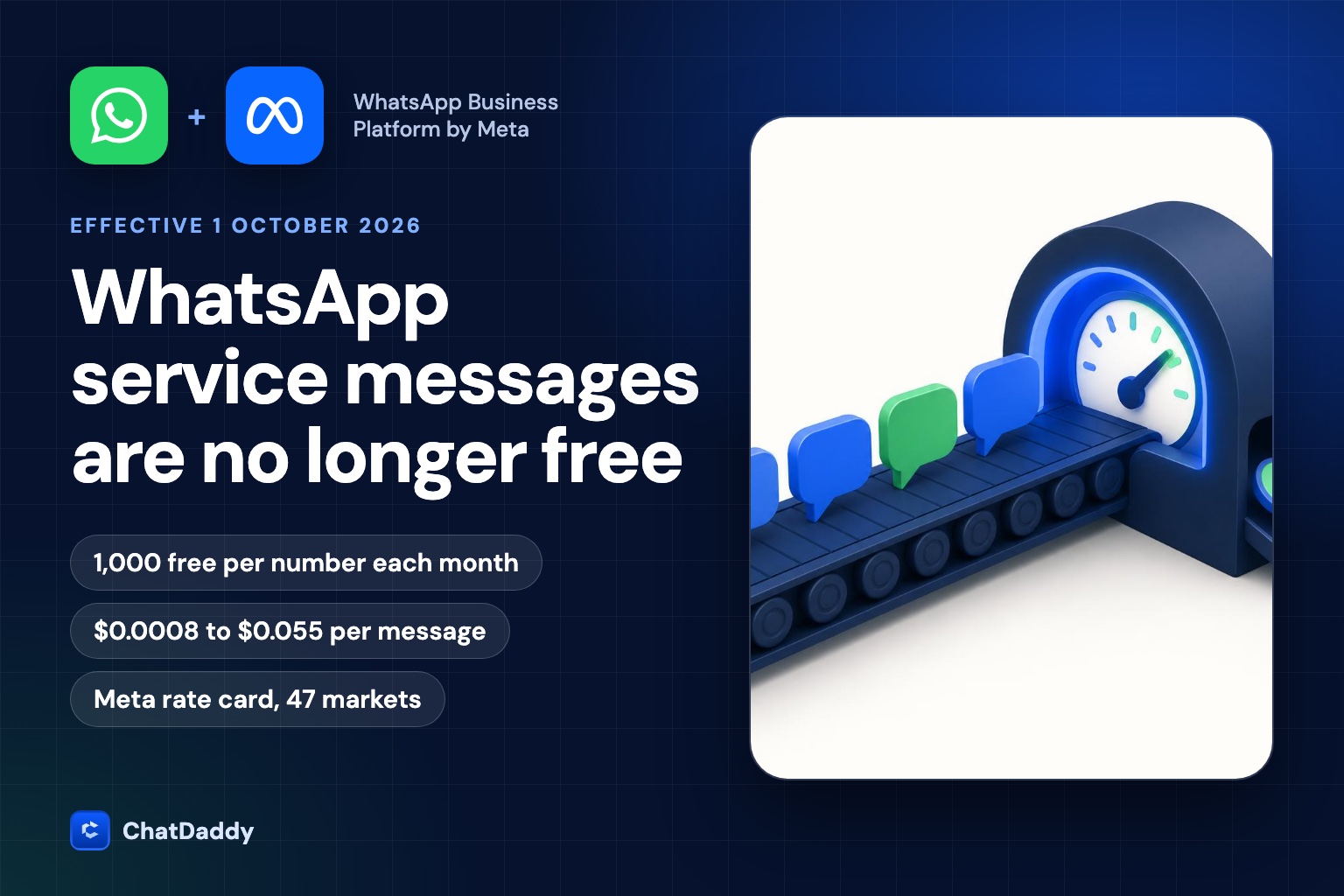
Until 30 September, replying to a customer inside the 24-hour customer service window cost nothing on the WhatsApp Business Platform. Service messages had been free since November 2024, and utility templates sent inside that window had been free since 1 July 2025. Meta's documentation now shows two changes taking effect on 1 October 2026: service messages are charged per message, and utility templates sent inside an open window are charged too.
Meta's documentation also keeps the other rules you may already know. Messages you receive are never charged. Marketing, authentication and out-of-window utility templates were already billed. And a single message is only ever charged under one category, so a service reply that contains promotional text is not charged again as marketing.
How service messages are billed
- Per delivered message. Meta counts delivered service messages against the free tier and bills from the 1,001st.
- The market is the customer's. The rate depends on the recipient's country calling code, not where your business sits.
- The rate equals the utility rate for that market. Meta's 1 October 2026 rate card now has a separate Service column, and in every market it matches the utility and authentication rate.
- No volume tiers. Utility and authentication messages can get cheaper as your monthly volume grows. Service messages cannot.
- 1,000 free per business phone number per month. The free tier does not roll over and resets at midnight in your account's time zone.
- A payment method is required. Without one, Meta still delivers service messages inside the free tier but stops delivering them once it is used up. Add one in Billing Hub before the first busy day.
- Free entry point windows stay free. If a customer messages you from a Click to WhatsApp ad and you reply, Meta does not charge for marketing, utility, authentication or service messages while that window is open.
- Eligible governments and non-profits keep free service messages beyond the free tier until 31 December 2027.
What service messages cost by market
These figures come straight from Meta's USD rate card effective 1 October 2026. The last three columns assume a single business number, no free entry point traffic, and only delivered service messages. The math is (messages - 1,000) x rate.
| Market | Rate per message | Per 1,000 beyond the free tier | 5,000 / month | 20,000 / month | 100,000 / month |
|---|---|---|---|---|---|
| North America | $0.0034 | $3.40 | $13.60 | $64.60 | $336.60 |
| Brazil | $0.0068 | $6.80 | $27.20 | $129.20 | $673.20 |
| Mexico | $0.0085 | $8.50 | $34.00 | $161.50 | $841.50 |
| India | $0.0014 | $1.40 | $5.60 | $26.60 | $138.60 |
| Indonesia | $0.0250 | $25.00 | $100.00 | $475.00 | $2,475.00 |
| Malaysia | $0.0140 | $14.00 | $56.00 | $266.00 | $1,386.00 |
| Singapore | $0.0160 | $16.00 | $64.00 | $304.00 | $1,584.00 |
| Hong Kong | $0.0260 | $26.00 | $104.00 | $494.00 | $2,574.00 |
| Rest of Asia Pacific (incl. Philippines, Thailand, Vietnam) | $0.0113 | $11.30 | $45.20 | $214.70 | $1,118.70 |
| United Arab Emirates | $0.0157 | $15.70 | $62.80 | $298.30 | $1,554.30 |
| Saudi Arabia | $0.0107 | $10.70 | $42.80 | $203.30 | $1,059.30 |
| Turkey | $0.0009 | $0.90 | $3.60 | $17.10 | $89.10 |
| South Africa | $0.0095 | $9.50 | $38.00 | $180.50 | $940.50 |
| Nigeria | $0.0067 | $6.70 | $26.80 | $127.30 | $663.30 |
| Spain | $0.0200 | $20.00 | $80.00 | $380.00 | $1,980.00 |
| France | $0.0300 | $30.00 | $120.00 | $570.00 | $2,970.00 |
| United Kingdom | $0.0220 | $22.00 | $88.00 | $418.00 | $2,178.00 |
| Germany | $0.0550 | $55.00 | $220.00 | $1,045.00 | $5,445.00 |
Two things stand out. First, the spread is large: the same 20,000 replies cost $26.60 in India and $1,045.00 in Germany, a factor of about 39. Second, the free tier matters most for small teams. A business sending 1,000 service messages or fewer on one number a month pays nothing at all.
The full table for all 47 markets, plus a CSV and JSON download, is on our WABA pricing page.
Three worked examples
1. A dental clinic in Malaysia: 1,500 replies, 800 appointment confirmations
Service messages: (1,500 - 1,000) x $0.0140 = $7.00. Confirmations sent as utility templates inside an open window are now billed at $0.0140 each: 800 x $0.0140 = $11.20. New monthly Meta cost from these two lines: $18.20, where it was zero before 1 October.
2. An online retailer in Singapore: 20,000 replies, 6,000 order updates in the window
Service: (20,000 - 1,000) x $0.0160 = $304.00. Utility inside the window: 6,000 x $0.0160 = $96.00. Together $400.00 a month of charges that did not exist in September.
3. A support team in Germany: 100,000 replies, 30,000 order updates in the window
Service: (100,000 - 1,000) x $0.0550 = $5,445.00. Utility inside the window: 30,000 x $0.0550 = $1,650.00. Together $7,095.00 a month. If better answers cut the number of replies per conversation by a third, the service line drops to $3,611.63, saving $1,833.37 a month.
If an AI agent does the replying
An AI agent changes the bill in two ways. It usually sends more messages per conversation than a person, and every one of those messages is a billable service message after the free tier. Meta treats a reply as a service message whether a person or a third-party AI solution wrote it, and it applies one charge per message.
The message fee is often the smaller part of the cost. Meta's own comparison for 10,000 AI-powered messages in Brazil assumes a third-party AI agent costs roughly 2 US cents per message for lower-complexity answers and about 9 cents for higher-complexity ones, plus 0.68 cents of Meta delivery, so about 2 to 10 cents in total. Meta's own agent, Meta Business Agent, is billed per token at $2.00 per million tokens, which Meta estimates at about 4 to 5 US cents per message. In other words, in most markets the AI cost dominates the delivery cost, and getting a resolution in three messages instead of seven saves more than negotiating the per-message rate.
If your agent connects to the official WhatsApp Business Platform, it is billed like any other sender. If it uses an unofficial connection, none of this applies, and you carry a different risk: your number. We cover that in our guide to the WhatsApp MCP server for AI agents (coming soon).
Seven ways to lower the bill
- Reduce messages per resolution. Combine a greeting and the answer into one message, use list and reply buttons instead of asking the customer to type, and cut acknowledgement-only replies. Scenario 3 above shows what a one-third cut is worth.
- Use the free entry point window. Route ad traffic through Click to WhatsApp ads or Facebook call-to-action buttons. Messages in an open window are free, including templates.
- Know which window a message is in. A utility template sent inside an open window is billed, so it is worth checking whether it needs to be a template at all. A plain reply inside the window is a service message and uses the free tier first.
- Watch the free tier per number. The 1,000 free messages are per business phone number. Teams with several numbers get more free messages in total, but splitting one number only to collect free tiers fragments the customer experience and is not a plan we recommend.
- Measure before you guess. Query Meta's Pricing Analytics API with
pricing_categoryset toSERVICE, and read thecategory: serviceandtype: regularfields on message-status webhooks. - Keep a payment method on file so replies keep delivering after the free tier is used.
- Re-check each quarter. Meta can change rates on 1 January, 1 April, 1 July and 1 October with at least a month's notice for a rate-card update.
Who adds a markup
Meta's rate is the floor. What you pay on top depends on your provider. As of 13 October 2026, Twilio's WhatsApp page lists its own per-message fee of $0.005 for inbound and outbound messages, in addition to Meta's charges. Respond.io states that WhatsApp fees are not included in its subscription and are billed by Meta based on usage. AiSensy's pricing page states that the first 1,000 service messages per number each month are free and charges Rs 0.145 for each message after that in India. ChatDaddy charges zero markup on Meta's WhatsApp Business API message fees, so the rate in the table above is the delivery rate you pay.
How to forecast your bill
A simple model is enough:
- Count last month's replies sent inside the 24-hour window, per number and per country.
- Subtract 1,000 per number, never below zero.
- Multiply by the market's service rate. Do this per country, because the rate follows the recipient.
- Add the utility templates you send inside the window at the utility rate, then the marketing, authentication and out-of-window utility templates you already paid for.
- Subtract anything that arrives through a free entry point window.
Our calculator does the same sum with all 47 markets and shows the before and after difference. For how Coexistence changes who sends what from the WhatsApp Business app, see our guide to what you keep and lose with WhatsApp Coexistence.
Work out your own number
Pick your country and monthly volumes in our free calculator. It uses Meta's official rate card effective 1 October 2026, and ChatDaddy adds no markup to Meta's fees.
Open the WhatsApp cost calculatorFrequently asked questions
Are WhatsApp service messages free in 2026?
Not after 1 October 2026. Each business phone number gets 1,000 free service messages per month, and Meta charges per message from the 1,001st at the utility rate of the recipient's market. Messages inside a free entry point window and eligible government and non-profit service messages are still free.
How much does one WhatsApp service message cost?
It depends on the market. From Meta's 1 October 2026 USD rate card: North America $0.0034, Brazil $0.0068, Malaysia $0.0140, Singapore $0.0160, United Kingdom $0.0220, Germany $0.0550 per message.
Do I pay for messages my customers send me?
No. Meta does not charge for messages from a user to a business.
Is the 1,000 free messages per business or per number?
Per business phone number, per month. It does not roll over, and it resets at midnight in the messaging account's time zone.
What happens if I have no payment method on file?
Meta delivers service messages inside the free tier but does not deliver them after the free tier is used up. Add a payment method in Billing Hub.
Does ChatDaddy add a markup to Meta's service message fees?
No. ChatDaddy charges zero markup on Meta's WhatsApp Business API message fees.
Sources
- Meta for Developers: Pricing on the WhatsApp Business Platform
- Meta for Developers: Pricing for non-template messages (service, utility in window, Meta Business Agent)
- Meta WhatsApp Business Platform rate card, USD, effective 1 October 2026 (rate-card file linked from the pricing page)
- Meta for Developers: pricing policy for AI Providers
- Twilio: WhatsApp pricing
- Respond.io: pricing
- AiSensy: pricing
- ChatDaddy: WhatsApp Business API pricing by country, with CSV and JSON data