AI Chatbot for WhatsApp 2026: Complete Guide to Building Smart Bots
WhatsApp isn't just a chat app anymore — it's the world's largest sales floor. With 3.3 billion monthly active users in 2026 and open rates above 95%, businesses that deploy AI chatbots on WhatsApp are converting leads while their competitors sleep. An AI chatbot doesn't just reply to messages. It understands intent, qualifies prospects, recommends products, and closes deals — all without a human lifting a finger.
In this comprehensive guide, you'll learn how AI chatbots for WhatsApp actually work, what separates a smart bot from a dumb one, how to build your first AI-powered bot in under an hour, and why over 23,500 businesses trust ChatDaddy — an official Meta ISV Partner — to power their WhatsApp automation. Whether you're running an e-commerce store, a SaaS company, or a service business, this is your blueprint for turning WhatsApp into an AI-driven revenue machine.
Table of Contents
- What Is an AI Chatbot for WhatsApp?
- How AI WhatsApp Chatbots Actually Work (NLP Explained)
- 7 Business Benefits of AI Chatbots on WhatsApp
- Must-Have Features in an AI WhatsApp Chatbot
- How to Build an AI WhatsApp Chatbot in Under 60 Minutes
- AI Chatbot Use Cases That Drive Revenue
- AI WhatsApp Chatbot Platforms Compared (2026)
- AI Lead Qualification: Turn Conversations into Sales
- Measuring AI Chatbot Performance
- FAQ
What Is an AI Chatbot for WhatsApp?
Think of a traditional chatbot as a phone tree — press 1 for sales, press 2 for support. An AI chatbot is more like a skilled salesperson who listens, understands what the customer actually wants, and responds naturally. The difference matters because WhatsApp conversations are informal. Customers type in slang, abbreviations, voice notes, and half-sentences. A rule-based bot breaks. An AI bot adapts.
AI WhatsApp chatbots connect through the official WhatsApp Business API, which means they can handle thousands of simultaneous conversations, send rich media (images, videos, documents, interactive buttons), and integrate with your CRM, e-commerce platform, and payment systems.
The technology stack typically includes:
- Natural Language Processing (NLP) — understands what customers are saying regardless of phrasing
- Intent recognition — classifies messages into actionable categories (buying, complaining, asking, browsing)
- Entity extraction — pulls key information like product names, dates, quantities, and budgets from messages
- Contextual memory — remembers previous messages in the conversation to provide relevant responses
- Machine learning — improves response accuracy over time based on conversation data
ChatDaddy's AI chatbot combines all of these capabilities with a no-code builder, so you get enterprise-grade AI without needing a data science team.
How AI WhatsApp Chatbots Actually Work (NLP Explained)
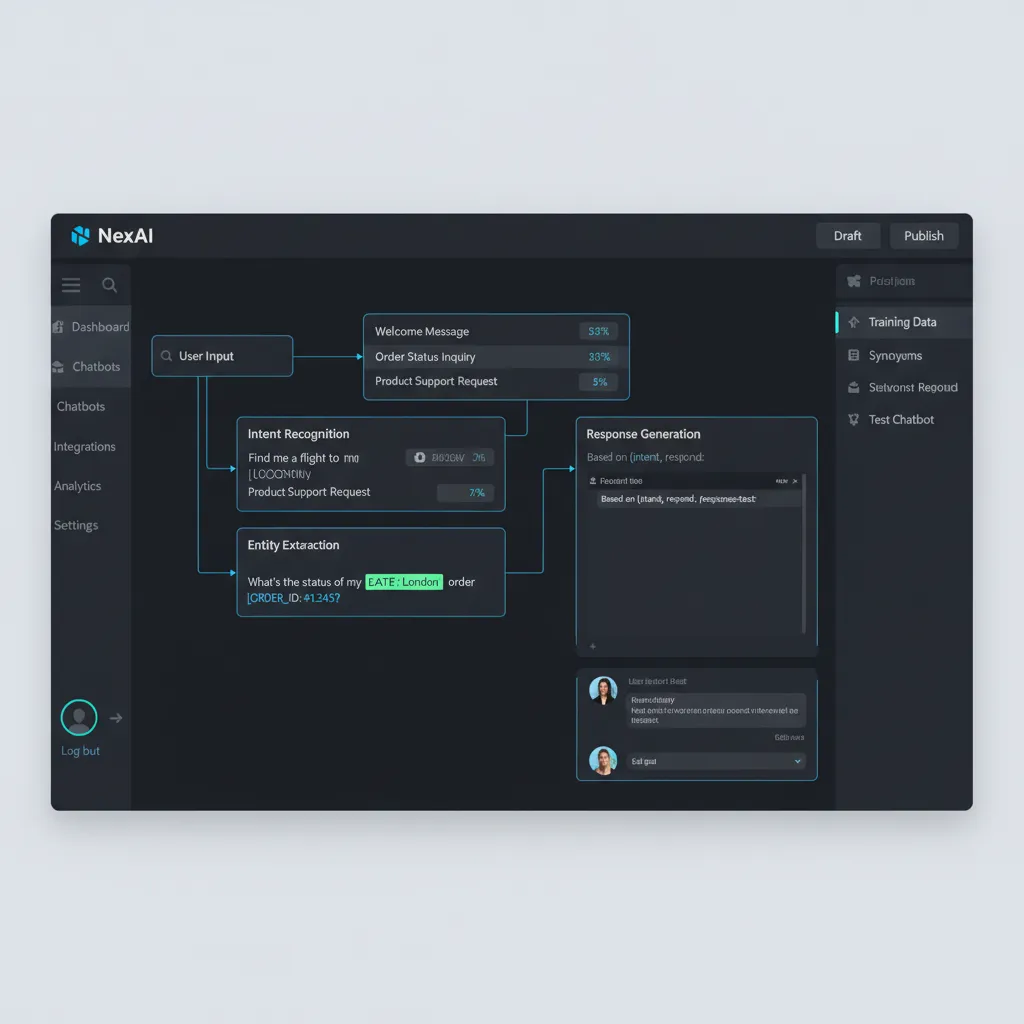
Here's what happens in the 200 milliseconds between a customer sending "hey, do you have that blue jacket in XL?" and the bot responding:
- Message received — The WhatsApp Business API delivers the message to your chatbot platform (like ChatDaddy)
- Preprocessing — The NLP engine normalizes the text — fixing typos, expanding abbreviations ("u" becomes "you"), and identifying the language
- Intent classification — The AI determines what the customer wants. In this case: product inquiry + size availability check
- Entity extraction — The bot pulls out "blue jacket" (product) and "XL" (size) as structured data
- Knowledge base lookup — The bot queries your product catalog, inventory system, or FAQ database
- Response generation — The AI composes a natural, contextual reply: "Great choice! The Blue Alpine Jacket is available in XL. It's $89 and ships free. Want me to send a checkout link?"
- Learning loop — If the customer buys, the bot records that this conversation pattern led to conversion, strengthening similar future responses
The difference between a good AI chatbot and a mediocre one is in steps 3-6. Cheap bots use keyword matching ("blue" + "jacket" = show jackets). Smart bots like ChatDaddy's understand conversational context — if a customer previously asked about winter clothing, the bot knows "that jacket" refers to a recently discussed item, not just any jacket.
Multilingual NLP: Speak Your Customer's Language
WhatsApp is global. Your customers might write in English, Malay, Hindi, Spanish, Arabic, or switch between languages mid-sentence (code-switching). Advanced AI chatbots handle multilingual conversations natively. ChatDaddy supports 100+ languages and can detect language automatically, responding in the customer's preferred language without manual configuration.
7 Business Benefits of AI Chatbots on WhatsApp
1. Instant 24/7 Response
Leads don't follow business hours. An AI chatbot responds in seconds at 3 AM on a Sunday, capturing the customer while their intent is hot. Research shows that responding within 5 minutes makes you 21x more likely to qualify a lead than waiting 30 minutes (Lead Response Management Study).
2. Automated Lead Qualification
Instead of your sales team spending hours asking basic questions, the AI bot handles qualification: budget, timeline, company size, specific needs. Only qualified leads reach a human agent. This alone can save 15-20 hours per week for a small sales team.
3. Support Cost Reduction
AI chatbots handle 60-80% of support queries without human intervention. For a team processing 500 tickets/week, that's 300-400 conversations handled automatically. At an average support cost of $8/ticket, that's $2,400-3,200 saved weekly.
4. Higher Conversion Rates
AI chatbots don't just answer questions — they sell. By analyzing conversation patterns, they recommend products, offer relevant upsells, and create urgency. Businesses using AI chatbots on WhatsApp report 25-40% higher conversion rates compared to static product pages.
5. Unlimited Scalability
A human agent handles 3-5 conversations simultaneously. An AI chatbot handles thousands. During flash sales, product launches, or seasonal peaks, the bot scales instantly while maintaining response quality.
6. Consistent Brand Experience
Human agents have good days and bad days. AI bots deliver the same quality every time — same tone, same accuracy, same helpfulness. This consistency builds trust, especially for brands serving customers across multiple regions.
7. Rich Analytics and Insights
Every conversation generates data. AI chatbots track conversion funnels, identify common objections, measure response effectiveness, and reveal what customers actually want. This intelligence feeds back into your product, marketing, and sales strategy.
Must-Have Features in an AI WhatsApp Chatbot
Not all chatbot platforms are equal. Here's what to demand from your AI WhatsApp chatbot provider:
No-Code Visual Builder
You shouldn't need developers to build or modify chatbot flows. ChatDaddy's drag-and-drop builder lets marketing and sales teams create sophisticated AI flows in minutes. Add conditions, branches, API calls, and media — all visually.
Smart Human Handoff
AI handles routine queries, but complex situations need human empathy. The best bots detect frustration, high-value opportunities, or edge cases and seamlessly transfer to a human agent via the shared inbox — with full conversation context so the customer never repeats themselves.
E-Commerce Integration
Connect your Shopify, WooCommerce, or custom store. The bot should be able to check inventory, process orders, send tracking updates, and handle returns directly in WhatsApp. ChatDaddy integrates with major platforms out of the box.
Drip Campaign Automation
Nurture leads over time with automated message sequences. A customer who inquired about a product but didn't buy gets a follow-up 24 hours later with a review, then a discount 48 hours later. All automated, all personalized through the broadcast feature.
How to Build an AI WhatsApp Chatbot in Under 60 Minutes
Here's your step-by-step blueprint:
- Sign up at chatdaddy.tech — start with the free plan, free trial credits included
- Connect your WhatsApp number — ChatDaddy walks you through Meta Business verification. As an official Meta ISV Partner, the process is streamlined and typically takes under 10 minutes.
- Define your bot's purpose — lead qualification? Customer support? Order management? Product recommendations? Start with one primary use case.
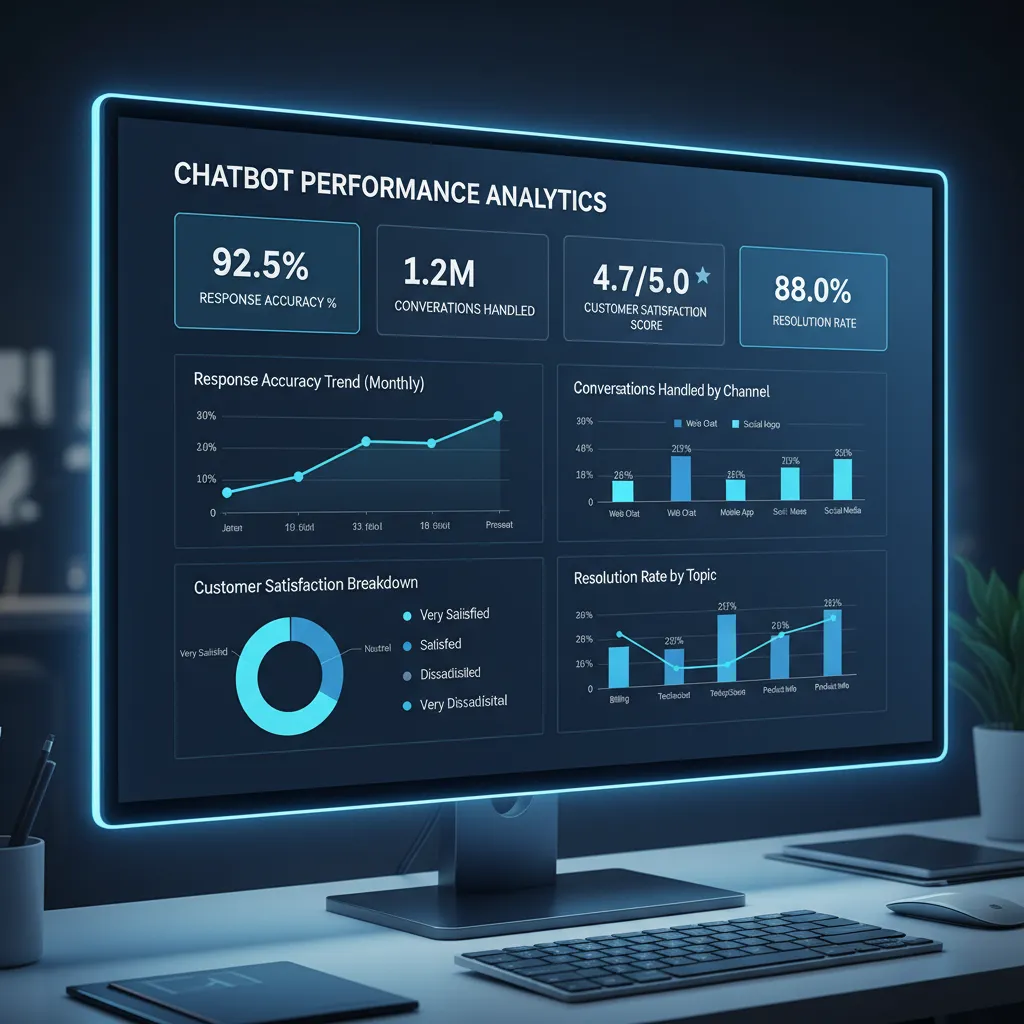
- Build your conversation flow — use the visual builder to map out the customer journey. Start with a welcome message, add qualifying questions, branch based on answers, and end with a CTA or human handoff.
- Train the AI — upload your FAQ document, product catalog, and common customer questions. The AI learns your specific business context.
- Add integrations — connect your CRM, e-commerce platform, Google Sheets, or any tool via Zapier to make the bot actionable, not just conversational.
- Test with your team — send test messages, try edge cases, verify integrations work correctly.
- Launch and monitor — go live and watch the analytics dashboard. Refine flows based on real conversation data.
Most businesses have a functional AI chatbot running within 30-60 minutes. The AI improves continuously after launch as it processes more conversations.
Build Your AI WhatsApp Chatbot Today
Join 23,500+ businesses using ChatDaddy to automate sales, qualify leads, and deliver instant support on WhatsApp — powered by AI.
Start Free TodayAI Chatbot Use Cases That Drive Revenue
Click-to-WhatsApp Ad Qualification
You run Click-to-WhatsApp ads on Facebook and Instagram. Every click opens a WhatsApp conversation. Instead of a human answering each one, the AI bot greets the lead, asks 3-4 qualifying questions (budget, timeline, company size), scores the lead, and routes hot prospects to your sales team instantly. Cold leads enter an automated nurture sequence.
Result: Your sales team only talks to qualified buyers, and every ad click gets an instant response — even at midnight.
E-Commerce Product Recommendations
A customer messages "I need a gift for my wife's birthday, budget around $50." The AI bot understands the intent, filters your catalog by price range and gift categories, and presents 3-5 curated options with images and buy buttons. If the customer hesitates, the bot offers a 10% discount code.
Abandoned Cart Recovery
A Shopify customer adds items to cart but leaves without purchasing. ChatDaddy sends an automated WhatsApp message 1 hour later with the cart contents, product images, and a one-click checkout link. Recovery rates hit 25-35% — 3-5x better than email recovery campaigns.
Appointment Booking
Service businesses (clinics, salons, consultancies) use AI chatbots to handle the entire booking flow: show available time slots, collect customer details, confirm the appointment, and send reminders 24 hours before. No receptionist needed.
Post-Purchase Upselling
Three days after a customer receives their order, the AI bot sends a personalized message: "How's the Blue Alpine Jacket? Customers who bought this also loved our matching beanie — here's 15% off." This automated cross-selling generates 10-15% additional revenue from existing customers.
AI WhatsApp Chatbot Platforms Compared (2026)
| Feature | ChatDaddy | WATI | Respond.io | Tidio | Manychat |
|---|---|---|---|---|---|
| Free Plan | Yes | No | No | Limited | Limited |
| Starting Price | $119/mo | $49/mo | $99/mo | $29/mo | $15/mo |
| AI/NLP Engine | Built-in, advanced | Basic | Advanced | Moderate | Basic |
| No-Code Builder | Visual drag-and-drop | Flow builder | Workflows | Visual | Visual |
| Multilingual | 100+ languages | Limited | Multi-language | Limited | Limited |
| Human Handoff | Smart, with context | Basic | Advanced | Basic | Basic |
| Meta ISV Partner | Yes | Yes | Yes | No | No |
| Shared Inbox | Up to 15 teammates | 5 agents | 5 users | 3 operators | N/A |
| Coexistence | Yes — use API + WhatsApp Business App on same number (free) | No | No | No | No |
| Best For | AI-first businesses globally | Indian market SMBs | Enterprise teams | Website + WhatsApp | Social media bots |
For businesses that want genuine AI capabilities (not just rule-based flows), ChatDaddy stands out as the only platform offering a free plan with no-code chatbot builder (AI features on Pro & Max plans), up to 15 teammates, and native WhatsApp API integration. Most competitors charge $49-99/month just to access basic automation.
AI Lead Qualification: Turn Conversations into Sales
Lead qualification is where AI chatbots deliver the highest ROI. Here's a proven qualification framework for WhatsApp:
The BANT Framework, Automated
- Budget — "What's your approximate budget for this project?" The bot captures the number and tags the lead accordingly.
- Authority — "Are you the decision-maker, or should we include someone else?" Identifies whether you're talking to the buyer.
- Need — "What's your biggest challenge with [pain point]?" Maps the response to your solution's capabilities.
- Timeline — "When are you looking to get started?" Separates "just browsing" from "ready to buy this week."
The AI bot asks these questions conversationally — not like a form. Based on responses, it calculates a lead score and takes action:
- Score 80-100 (Hot) — Instant notification to sales team + calendar link for a demo
- Score 50-79 (Warm) — Enter drip campaign with case studies, testimonials, and a limited-time offer
- Score 0-49 (Cold) — Educational content sequence + re-engagement after 30 days
ChatDaddy's AI takes this further by analyzing conversational signals — urgency in language, engagement speed, question specificity — to refine lead scores beyond simple BANT answers.
Measuring AI Chatbot Performance
You can't improve what you don't measure. Track these metrics weekly in your ChatDaddy dashboard:
Containment Rate
What percentage of conversations does the bot resolve without human help? Industry benchmark: 60-80%. If yours is below 50%, your AI needs retraining or your flows have gaps.
Average Response Time
AI bots should respond in under 2 seconds. If response times are higher, check your API integrations — a slow inventory lookup can bottleneck the entire conversation.
Conversion Rate
Of all conversations the bot handles, how many result in a purchase, booking, or qualified lead? Track this at each stage of the funnel to identify where prospects drop off.
Revenue Per Conversation
Total revenue attributed to bot conversations divided by total conversations. This is your north star metric. ChatDaddy users see $2-15 revenue per bot conversation depending on their industry and average order value.
CSAT Score
Send a quick satisfaction survey after bot interactions. Aim for 4.2+ out of 5. Anything below 3.8 means customers are frustrated with the bot experience.
Related Articles
- WhatsApp Automation: The Complete Guide for 2026
- WhatsApp Business Automation Tool: Automate Sales & Support in 2026
- WhatsApp Chatbot: The Complete Guide to Building AI-Powered Bots in 2026
- WhatsApp Chatbot Builder No Code: Create Powerful Bots in Minutes (2026 Guide)
- WhatsApp Chatbot Dubai: Automate Customer Service for UAE Businesses in 2026
- WhatsApp Lead Generation: Capture and Convert Leads 3-5x Faster
- WhatsApp Customer Support: Build a Help Desk That Scales
- WhatsApp Sales Automation: Automate Your Sales Pipeline in 2026
Frequently Asked Questions
What is the best AI chatbot for WhatsApp in 2026?
ChatDaddy is the best AI chatbot for WhatsApp in 2026, offering a free plan with no-code visual chatbot builder (AI-powered NLP on Pro & Max plans), up to 15 teammates, and native Meta ISV Partner integration. It serves 23,500+ businesses and supports 100+ languages, making it suitable for businesses of all sizes globally.
Can an AI chatbot really sell products on WhatsApp?
Yes. AI chatbots on WhatsApp can recommend products based on customer preferences, share product images and descriptions, process orders, handle payments, and follow up with cross-sell offers. Businesses report 25-40% higher conversion rates compared to website-only sales.
How much does an AI WhatsApp chatbot cost?
Prices range from free (ChatDaddy's starter plan) to $99+/month for enterprise platforms. ChatDaddy's plans are: Free (basic features), Basic at $119/month, Pro at $299/month, and Max at $799/month. The WhatsApp Business API charges separately per conversation, with free service replies within 24 hours.
Do I need coding skills to build a WhatsApp AI chatbot?
No. Platforms like ChatDaddy offer no-code visual builders where you drag and drop conversation elements, add AI responses, set conditions, and connect integrations — all without writing a single line of code. You can have a working bot in under 60 minutes.
How does an AI chatbot handle questions it doesn't understand?
Good AI chatbots have fallback strategies: they ask clarifying questions, offer menu options, or seamlessly transfer to a human agent with full conversation context. ChatDaddy's AI also learns from these "miss" conversations to improve future accuracy.
Can an AI WhatsApp chatbot work in multiple languages?
Yes. ChatDaddy's AI chatbot supports 100+ languages and can automatically detect the customer's language from their first message, responding in the same language without manual configuration. It even handles code-switching (mixing languages in one message).
Is WhatsApp chatbot messaging compliant with privacy regulations?
Yes, when using the official WhatsApp Business API through a certified partner like ChatDaddy. The API requires opt-in consent for marketing messages, provides end-to-end encryption, and complies with GDPR and other privacy frameworks. ChatDaddy handles data in accordance with Meta's business messaging policies.
What is the difference between a rule-based and AI chatbot for WhatsApp?
A rule-based chatbot follows pre-set scripts and breaks when users say anything unexpected. An AI chatbot uses natural language processing to understand intent, handle varied phrasing, maintain conversation context, and improve over time. AI bots deliver significantly better user experiences and higher conversion rates.