WhatsApp Sales Automation: The Complete Guide to Automating Your Sales Pipeline in 2026
By ChatDaddy Team
March 28, 2026
Last updated: March 28, 2026
12 min read

Every minute your sales team spends copy-pasting follow-up messages, manually qualifying leads, and chasing unresponsive prospects is a minute they're not closing deals. In 2026, the fastest-growing sales teams have moved this entire workload onto WhatsApp automation — and the results are staggering. WhatsApp messages carry a 95-98% open rate, a reply rate 8x higher than email, and a conversion rate that makes every other channel look obsolete.
The challenge is that most sales automation guides focus on email sequences and CRM workflows designed for Western markets. WhatsApp sales automation is different — it's conversational, it's immediate, and it requires a platform built specifically for the WhatsApp Business API. That's exactly what ChatDaddy delivers: a Meta ISV Partner platform trusted by 23,500+ businesses worldwide, with tools purpose-built for automating every stage of your WhatsApp sales pipeline.
This guide covers everything: what WhatsApp sales automation actually means, the six core workflows that drive results, how to build them, and a real ROI calculation so you can see the numbers before you commit.
What Is WhatsApp Sales Automation?
WhatsApp sales automation is the use of chatbots, drip sequences, and trigger-based workflows connected to the WhatsApp Business API to automatically capture leads, qualify prospects, send follow-up messages, book appointments, and recover abandoned carts — without manual intervention from your sales team.
WhatsApp sales automation is not about replacing human sales reps. It is about removing the repetitive, low-value tasks that eat up their time so they can focus on conversations that actually close deals. A well-built automation system on WhatsApp handles the top and middle of your funnel around the clock — and hands off warm, qualified leads to your team exactly when human judgment is needed.
In practice, this looks like:
- A prospect clicks a Facebook ad and lands in a WhatsApp conversation — a chatbot greets them, asks three qualification questions, and segments them automatically
- Over the next five days, they receive a drip sequence of case studies, product demos, and social proof — all via WhatsApp, all automated
- When they reply with a buying signal, the conversation is instantly routed to the right sales agent with full context
- After the call, an automated follow-up lands in their WhatsApp with the proposal PDF and a one-click appointment booking link
This entire sequence runs without your sales team touching a single message. The platform that makes it possible is the WhatsApp Business API — the official, scalable version of WhatsApp designed for businesses. Unlike the free WhatsApp Business App, the API supports unlimited automation, multi-agent inboxes, broadcast messaging, and integration with your CRM, e-commerce platform, and business tools.
To access the API, you need a verified platform partner. ChatDaddy is an official Meta ISV Partner (Independent Software Vendor) — not a BSP (Business Solution Provider). This distinction matters: as an ISV, ChatDaddy builds its own proprietary software on top of the API rather than simply reselling access, which means better features, faster development, and 0% markup on Meta's messaging fees. You pay Meta's published rates directly — no hidden markup.
Why Automate Sales on WhatsApp?
Businesses that automate sales on WhatsApp see 3-5x higher lead conversion rates, 60-80% reduction in response time, 25-35% cart recovery rates, and 40-60% reduction in sales team workload — because WhatsApp's 95-98% open rate and immediate delivery makes it the highest-converting sales channel available in 2026.
The case for WhatsApp sales automation comes down to three unavoidable realities about how buyers behave today:
Reality 1: Speed Determines Who Gets the Sale
A landmark study by Harvard Business Review found that responding to a lead within 5 minutes makes you 100 times more likely to connect than responding after 30 minutes. Most sales teams average 2-4 hours for first response. WhatsApp automation delivers an instant reply — every time, at any hour, on any day. The lead never goes cold because there is no wait.
Reality 2: WhatsApp Has the Highest Attention of Any Channel
Consider how your own customers actually behave. Email open rates hover around 20%. SMS open rates reach 85-90% but feel intrusive for marketing. WhatsApp messages achieve 95-98% open rates with an average read time under 3 minutes — because people treat WhatsApp as a personal inbox, not a marketing channel. A drip sequence on WhatsApp does not get buried in a promotions folder. It appears next to messages from family and friends.
Reality 3: Repetitive Sales Tasks Are Costing You Real Money
Research by McKinsey found that sales representatives spend only 34% of their time actually selling. The remaining 66% goes to administrative work: data entry, sending follow-ups, qualifying unfit prospects, answering the same questions repeatedly. WhatsApp automation eliminates most of that 66% — and redirects your team's energy to closing.
| Sales Task |
Without Automation |
With WhatsApp Automation |
| Lead response time | 2-4 hours average | Under 30 seconds |
| Lead qualification | 15-20 min per lead | Automated, 0 min |
| Follow-up sequences | Manual, inconsistent | Automated, 100% consistent |
| Appointment booking | 5-10 email/message exchanges | 1-click in WhatsApp |
| Cart recovery | 0-10% recovery rate | 25-35% recovery rate |
| After-hours coverage | None | Full 24/7 automation |
"Before WhatsApp automation, our team spent three hours every morning copy-pasting follow-up messages. Now that time goes to actual sales calls. We closed 40% more deals in the first quarter after going live." — SaaS sales director, 12-person team
6 Key WhatsApp Sales Automation Workflows
There are six automation workflows that consistently deliver the highest ROI for sales teams. Implement all six and you have a complete automated sales pipeline — one that works while your team sleeps.
1. Automated Lead Capture
WhatsApp lead capture automation connects Click-to-WhatsApp ads, website chat buttons, QR codes, and landing page CTAs directly to automated welcome sequences that collect name, email, company, and intent data — creating a CRM-ready lead record without any manual data entry.
Every lead source you have — Facebook ads, Google ads, website visitors, trade show badge scans, business card QR codes — can funnel directly into a WhatsApp conversation. The moment a prospect initiates contact, automation takes over immediately.
Click-to-WhatsApp Ads
Facebook and Instagram ads with a "Send Message" CTA open a WhatsApp conversation when tapped. ChatDaddy connects to these ad campaigns and triggers an instant automated welcome message the moment the conversation starts. No one needs to be online. Your team wakes up to a list of qualified leads who entered the pipeline overnight.
The welcome flow collects:
- First name (for personalization throughout the sequence)
- Company name and size (for segmentation)
- Primary pain point or reason for inquiry (for routing)
- Contact details for your CRM
Website Chat Button
Replace your website's live chat widget with a WhatsApp button. When visitors click it, they open a pre-filled WhatsApp message referencing the page they were on — giving your automation immediate context. A visitor from your pricing page gets a different automated sequence than a visitor from your case studies page.
QR Codes at Physical Touchpoints
Print QR codes on business cards, product packaging, in-store displays, and event banners. Scanning opens a WhatsApp conversation with a pre-set opening message, triggering the appropriate automated flow for that context.

2. Lead Qualification Chatbot
A WhatsApp lead qualification chatbot uses branching conversation logic to ask budget, timeline, authority, and need questions, then automatically scores leads as hot, warm, or cold — routing high-intent prospects directly to sales agents and placing lower-intent leads into nurture sequences without any human involvement.
Not every lead is ready to buy. Your sales team should only be talking to people who fit your ideal customer profile and have a genuine intent to purchase. A qualification chatbot filters your pipeline automatically, so your reps start every conversation with a warm lead who already understands your product.
Building Your Qualification Flow
Effective qualification chatbots ask four categories of questions — modeled on the BANT framework (Budget, Authority, Need, Timeline):
- Need: "What's the main challenge you're trying to solve?" — Routes the prospect to the right product track and personalizes subsequent messages
- Budget: "What's your monthly budget for this kind of solution?" — Filters out prospects who cannot afford your product before your team invests time
- Authority: "Are you the decision-maker for this purchase, or are others involved?" — Flags deals that need multi-stakeholder outreach
- Timeline: "When are you looking to implement a solution?" — Separates immediate opportunities from longer-term nurture candidates
ChatDaddy's Flow Builder lets you create these branching conversations with a drag-and-drop interface — no code required. Each answer triggers a different path. A prospect who says "under 30 days" and "I'm the decision-maker" gets routed to a sales agent immediately. A prospect who says "just exploring" gets placed into a 30-day nurture sequence.
AI-Powered Qualification (Pro and Max Plans)
On ChatDaddy's Pro and Max plans, the AI chatbot goes beyond scripted flows. It reads natural language responses — so if a prospect types "I need this before our product launch in April" instead of selecting a multiple-choice option, the AI understands the urgency, scores the lead accordingly, and routes it correctly. This makes qualification feel like a real conversation rather than a form.

3. WhatsApp Drip Sequences
WhatsApp drip sequences are time-based automated message series — typically 5-10 messages over 7-30 days — that nurture leads from awareness to purchase intent by delivering case studies, product demos, testimonials, and offers at pre-set intervals. WhatsApp drip sequences achieve 3-5x higher engagement than email drip campaigns due to the channel's open rates.
A drip sequence is your silent sales rep — working 24 hours a day, delivering the right message at the right moment in the buyer journey, completely automatically. On WhatsApp, drip sequences perform dramatically better than email because messages actually get read.
A 7-Day B2B Sales Drip Template
| Day |
Message Type |
Goal |
| Day 0 | Welcome + value proposition (30 sec video or carousel) | First impression, set expectation |
| Day 1 | Customer story — "How [Company] achieved [Result]" | Social proof, build credibility |
| Day 3 | Product demo video (2 min) + specific feature spotlight | Show the product in action |
| Day 5 | Common objection addressed — FAQ or myth-busting message | Remove purchase barriers |
| Day 6 | Comparison: "Why teams choose us over [Competitor]" | Competitive differentiation |
| Day 7 | Limited offer or CTA — "Book a 15-min call this week" | Drive conversion action |
Each message in the sequence includes a reply option or CTA button. When a prospect replies or clicks at any point, the automation pauses the drip and notifies a sales agent — because a reply is a buying signal that deserves a human response, not the next automated message.
Segmented Drip Sequences
The most effective drip campaigns are not one-size-fits-all. ChatDaddy lets you tag leads by industry, product interest, company size, or qualification score, then run separate drip sequences for each segment. A lead from healthcare gets different case studies than a lead from e-commerce. A small business lead gets pricing-focused content, while an enterprise lead gets ROI and security content.
ChatDaddy's 20x broadcast reach — the ability to reach 20 times more contacts per campaign than standard WhatsApp Business App limits — means you can run these segmented sequences at serious scale without hitting delivery bottlenecks.
4. Appointment Booking Automation
WhatsApp appointment booking automation eliminates the back-and-forth of scheduling by letting prospects select available time slots directly within the chat, sending instant confirmations, automated reminders 24 hours and 1 hour before the appointment, and no-show recovery messages — reducing no-show rates by 30-40% and cutting booking time from days to minutes.
Scheduling a sales call without automation looks like this: prospect expresses interest, rep checks calendar, rep sends availability via email, prospect responds two days later with a different preferred time, rep confirms — and the call is now booked five days after the initial interest, when momentum has already cooled.
With WhatsApp booking automation, the entire process happens inside the chat in under two minutes:
- Prospect indicates interest (replies to a drip message or triggers a CTA)
- Chatbot presents available time slots as quick-reply buttons
- Prospect taps their preferred time
- Confirmation message fires immediately with a calendar invite link
- Reminder message fires 24 hours before the call
- Another reminder fires 1 hour before the call
- If no-show: recovery message fires 15 minutes after the missed appointment with a rescheduling link
ChatDaddy integrates with Google Calendar and Calendly, so available slots shown in WhatsApp always reflect real-time calendar availability. No double-booking, no manual calendar management.
Industry-Specific Booking Flows
- B2B SaaS: Product demo booking with pre-call questionnaire (company size, current tools, use case) so the rep comes prepared
- Real Estate: Property viewing booking with location, preferred time, and number of attendees captured automatically
- Healthcare: Consultation booking with service type, insurance details, and pre-appointment intake form
- Professional Services: Discovery call booking with brief description of the project or challenge — giving advisors context before the call
Automate Your Entire WhatsApp Sales Pipeline
Join 23,500+ businesses using ChatDaddy to capture, qualify, and convert leads on autopilot. Free plan available — no credit card required.
Start Free Today
5. Automated Follow-Ups
Automated WhatsApp follow-up sequences send trigger-based messages after key sales events — proposal sent, demo completed, trial started, invoice unpaid — delivering timely nudges that keep deals moving without requiring sales reps to track and manually chase every open opportunity.
The majority of sales happen after the fifth follow-up contact. The majority of sales reps give up after the second. Automated follow-ups solve this gap entirely — by ensuring every lead gets a consistent, perfectly-timed follow-up sequence regardless of how busy your team is.
Trigger-Based Follow-Up Scenarios
Post-Demo Follow-Up
Two hours after a sales demo, an automated WhatsApp message sends the prospect a thank-you note, a link to the recording, and three bullet points summarizing the features most relevant to their stated pain points. The next day, another message follows with a one-page ROI calculation. Three days later, a check-in: "Any questions as you review?" — with quick-reply buttons for "Yes, let's talk" or "Send me pricing."
Proposal Follow-Up
Immediately after a proposal is sent (triggered by your CRM status update or a manual tag in ChatDaddy), an automated message confirms receipt and sets a response expectation. On day 3, a gentle check-in. On day 7, a case study from a similar company. On day 10, a value reinforcement message. On day 14, a deadline or incentive message if appropriate. The prospect never falls off the radar.
Trial Onboarding Follow-Up
For SaaS and software products, a WhatsApp sequence during the trial period dramatically improves conversion. Day 1: welcome and quick-start guide. Day 3: "Have you tried [key feature]?" with a 60-second video. Day 7: usage tip tailored to their industry. Day 10: mid-trial check-in with offer to book a success call. Day 13: trial ending reminder with upgrade CTA.
Re-Engagement Follow-Up
Leads that went cold get an automated re-engagement sequence 30, 60, and 90 days after last contact. These messages reference new product features, recent customer success stories, or a relevant industry trigger ("With [industry trend] happening, many teams are now looking at..."). A percentage of cold leads re-enter the active pipeline from re-engagement alone — leads your team had already written off.

6. Abandoned Cart Recovery
WhatsApp abandoned cart recovery automation sends a sequence of 2-3 messages to shoppers who added items to their cart but did not complete checkout — typically achieving 25-35% cart recovery rates, compared to 5-10% via email, because WhatsApp messages are read almost immediately after delivery.
Cart abandonment costs e-commerce businesses an estimated $260 billion per year globally. The standard email recovery sequence recovers 5-10% of abandoned carts. WhatsApp recovery sequences recover 25-35% — because your message arrives in a channel people actually watch.
The 3-Message Cart Recovery Sequence
- Message 1 — 1 hour after abandonment: Friendly reminder with a direct link back to the cart. No pressure, no urgency. Just "You left something behind — your cart is saved." Include a product image and the items left behind. Recovery rate from this message alone: 15-20%.
- Message 2 — 24 hours after abandonment: Address the most common reason for abandonment: price. Offer a time-limited discount (10-15%) or free shipping. "Your cart is still waiting — here's 10% off if you complete your order today." Include an expiry time for the offer. Adds another 8-12% recovery.
- Message 3 — 48 hours after abandonment: Final nudge with scarcity signal if applicable ("Only 3 left in stock") or social proof ("247 people bought this item this week"). After this message, exit the sequence — persistent messaging beyond three touchpoints risks opt-outs.
ChatDaddy connects to Shopify, WooCommerce, and other major e-commerce platforms via webhooks and Zapier. When a cart abandonment event fires in your store, the WhatsApp sequence triggers automatically with the customer's name, the specific products they left behind, and a personalized cart link.
Segmented Recovery by Cart Value
Not all abandoned carts are equal. Configure separate sequences based on cart value:
- High-value carts (above $200): Add a personal agent message on day 2 — "Hi [Name], I noticed you were looking at [Product]. I can help answer any questions." Human touch for high-value opportunities.
- Mid-value carts ($50-$200): Standard 3-message sequence with discount offer
- Low-value carts (under $50): Single reminder message with free shipping offer — keep it simple, keep it cheap
ChatDaddy Features for WhatsApp Sales Automation
ChatDaddy provides a complete WhatsApp sales automation platform including a no-code Flow Builder, AI chatbot (Pro and Max), broadcast messaging with 20x reach, shared team inbox with agent routing, CRM integrations, Shopify and WooCommerce connectivity, and analytics dashboards — all as an official Meta ISV Partner with 0% markup on Meta fees.
ChatDaddy's platform is built specifically for sales automation on WhatsApp. Here are the features that matter most for running the six workflows above:
No-Code Flow Builder
Drag-and-drop chatbot and automation builder with branching logic, time delays, conditional paths, and quick-reply buttons. Build qualification flows, drip sequences, booking flows, and cart recovery sequences without writing a single line of code. Pre-built Flow Templates (available on Pro and Max plans) give you a running start with proven workflows you can customize in minutes.
AI Chatbot (Pro and Max Plans)
Natural language processing that understands free-text replies — so your qualification chatbot works even when prospects don't follow the script. The AI handles objections, answers product questions from a knowledge base you define, and escalates to a human agent when it detects buying signals or frustration. Available on Pro ($299/month) and Max ($799/month) plans.
Shared Team Inbox with Smart Routing
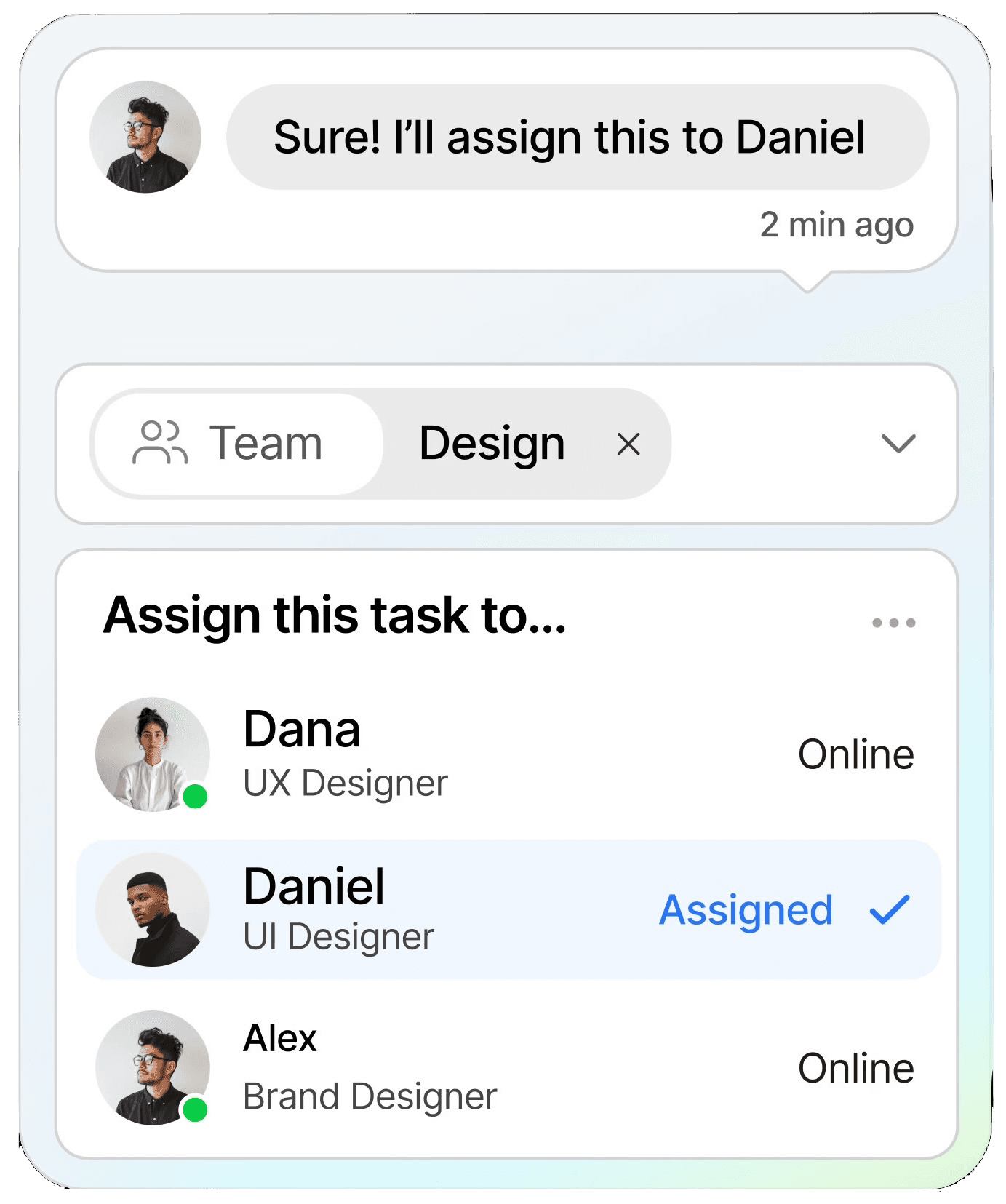
All WhatsApp conversations centralized in one inbox, with automatic routing based on keywords, lead score, or language. Sales reps see only their assigned leads, while managers have a full-team view. Internal notes and @mentions let teams collaborate on complex deals without the prospect ever seeing the back-and-forth. Supports up to 15 teammates on the Max plan.
Broadcast Messaging with 20x Reach
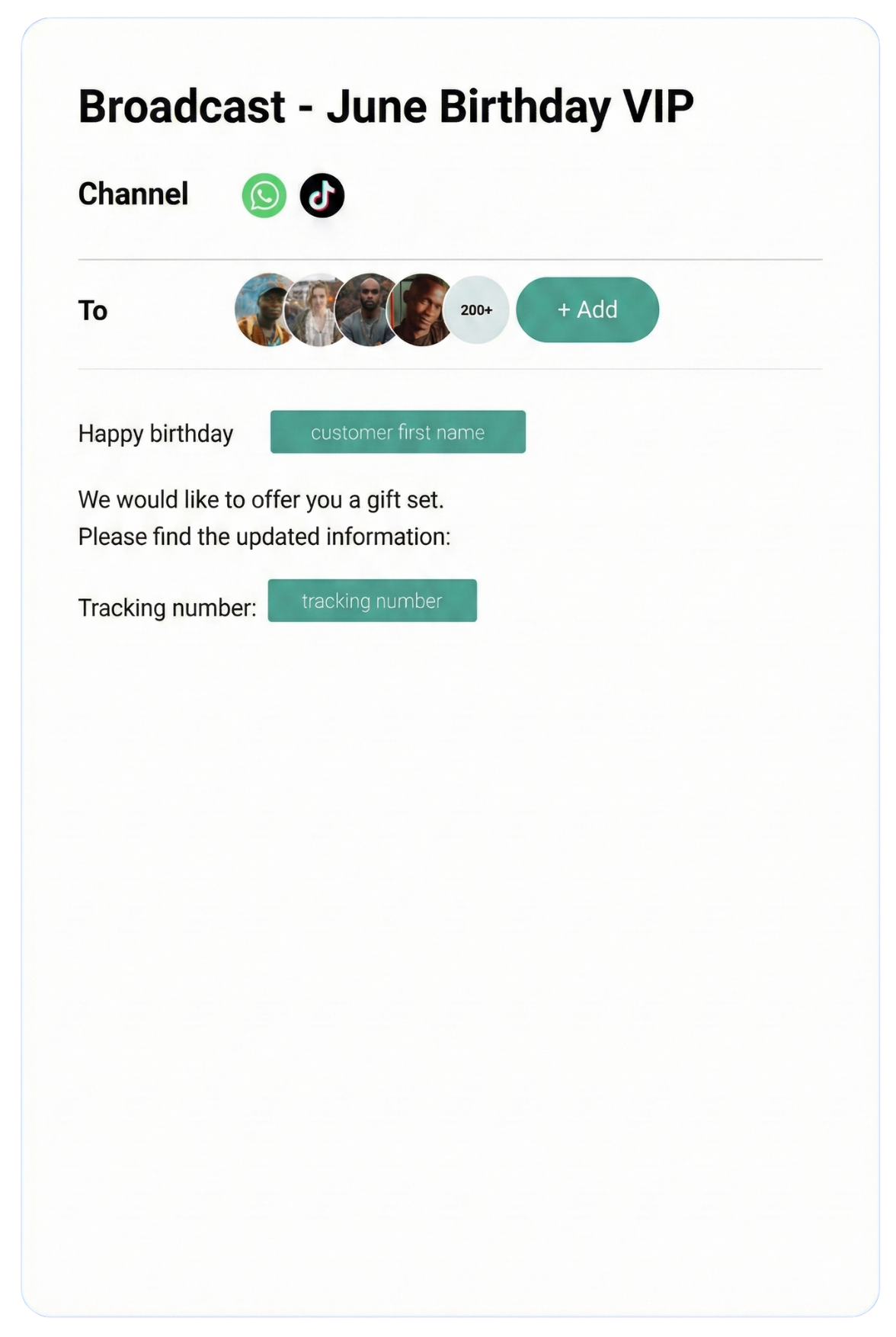
Send targeted broadcast messages to segmented contact lists at 20x the standard WhatsApp Business App limits. Schedule broadcasts in advance, personalize with merge tags ({firstName}, {companyName}, {lastPurchase}), and track delivery, open, and click rates. Essential for drip sequences at scale.
Coexistence — Keep Your WhatsApp Business App
ChatDaddy's unique coexistence feature lets you run the API and the regular WhatsApp Business App on the same phone number simultaneously — for free. No other platform offers this. Your team can handle personal WhatsApp conversations while the automation runs through the API in parallel. This is particularly valuable for small teams transitioning to API-based automation gradually.
CRM and E-Commerce Integrations
Native integrations with Shopify, WooCommerce, HubSpot, Google Sheets, and Zapier (connecting to 5,000+ apps). Trigger WhatsApp automations from CRM status changes, e-commerce events, form submissions, or any webhook. Sync contact data both ways — so lead information captured in WhatsApp flows into your CRM automatically.
Analytics and Reporting
Track message delivery rates, open rates, reply rates, chatbot completion rates, and agent response times from a unified dashboard. Measure which drip sequences convert best, which qualification questions cause drop-off, and which sales reps have the highest conversion rates. Data-driven optimization of every automation workflow.
Unlimited Contacts on All Paid Plans
Unlike some competitors that charge per contact, ChatDaddy's paid plans include unlimited contacts. Whether you have 1,000 leads or 1,000,000, your platform cost stays the same. This makes it particularly cost-effective for businesses with large contact databases running broadcast sequences.
Plans and Pricing
ChatDaddy offers four plans: Free ($0, 1 teammate), Basic ($119/month, 5 teammates), Pro ($299/month, 10 teammates, AI chatbot + Flow Templates), and Max ($799/month, 15 teammates, priority support). All paid plans include unlimited contacts. As a Meta ISV Partner, ChatDaddy charges 0% markup on Meta's WhatsApp messaging fees.
| Plan |
Price / Month |
Teammates |
Key Automation Features |
| Free | $0 | 1 | Basic chatbot, shared inbox, limited broadcasts |
| Basic | $119 | 5 | Full Flow Builder, broadcast messaging, unlimited contacts, Zapier integration |
| Pro | $299 | 10 | AI Chatbot, Flow Templates, advanced analytics, API access, CRM integrations, unlimited contacts |
| Max | $799 | 15 | Everything in Pro + priority support, dedicated account manager, custom integrations, unlimited contacts |
For most sales teams looking to implement all six automation workflows, the Pro plan at $299/month is the right starting point. It includes the AI chatbot for natural language qualification, Flow Templates for faster setup, advanced analytics for optimization, and API access for CRM integration — all with 10 teammates and unlimited contacts.
The Basic plan at $119/month is ideal for smaller teams (up to 5 teammates) that want lead capture, drip sequences, appointment booking, and cart recovery without the AI chatbot. Flow Builder on Basic handles all scripted workflows effectively.
Teams with 10+ sales reps handling high-volume pipelines, enterprise accounts, or multiple product lines should look at the Max plan at $799/month for the dedicated account manager and custom integration support.
All plans include the coexistence feature (use API and WhatsApp Business App on the same number) at no additional cost — a unique ChatDaddy advantage. And because ChatDaddy is a Meta ISV Partner (not a BSP reseller), there is 0% markup on Meta's WhatsApp messaging fees. You pay Meta's published rates directly, with no platform surcharge on top.
ROI Calculator: What WhatsApp Sales Automation Is Worth to Your Business
A 5-person sales team spending 2 hours daily on manual follow-up and lead qualification loses approximately $8,000-$12,000 per month in productivity cost. WhatsApp sales automation recovers 80% of this time, generates 25-35% more qualified pipeline from the same lead volume, and typically delivers 5-10x ROI within 90 days of implementation.
Here is a concrete ROI calculation for a mid-sized business with a 5-person sales team:
ROI Example: 5-Person Sales Team, $119/month Basic Plan
Average sales rep salary (fully loaded)
$60,000 / year = $28.85 / hour
Time spent on manual follow-ups & qualification (per rep per day)
2 hours / day
Annual cost of manual sales admin (5 reps)
$75,010 / year
Productivity recovered with automation (80%)
$60,008 / year saved
Additional revenue from faster response (20% more conversions)
Varies by deal size — typically $30,000-$100,000+ / year
Cart recovery revenue (e-commerce: 25% recovery on 1,000 abandoned carts/month at $50 avg)
$150,000 / year
Annual platform cost (Basic plan)
$1,428 / year
Conservative first-year ROI (productivity savings alone)
4,104% ROI
These numbers are deliberately conservative. They do not include the revenue impact of 24/7 lead coverage (capturing leads your team would have missed entirely), the lift from drip sequences moving more leads through the funnel, or the compounding benefit of consistent follow-up on every opportunity.
The $119/month Basic plan pays for itself within the first week — from productivity savings alone, before counting a single additional sale.
"We implemented ChatDaddy for our 8-person sales team in January. By March, our pipeline had grown 60% from the same lead volume — because every lead was getting followed up properly, not just the ones our reps happened to remember." — Sales Manager, B2B technology company
Start Automating Your WhatsApp Sales Pipeline Today
ChatDaddy is trusted by 23,500+ businesses worldwide. Free plan available. As a Meta ISV Partner, we provide 0% markup on messaging fees and unlimited contacts on all paid plans.
Get Started Free
Frequently Asked Questions
What is WhatsApp sales automation?
WhatsApp sales automation uses chatbots, drip sequences, and trigger-based workflows connected to the WhatsApp Business API to automatically handle lead capture, qualification, follow-ups, appointment booking, and cart recovery. It removes repetitive manual sales tasks so your team focuses on high-value conversations that close deals. Platforms like ChatDaddy provide all the tools needed to build and run these automations without coding.
Is WhatsApp automation legal for sales and marketing?
Yes, WhatsApp automation is legal when used through the official WhatsApp Business API via an authorized Meta partner. The API enforces opt-in consent requirements — you can only send marketing messages to contacts who have explicitly opted in. Unsolicited bulk messaging through unofficial tools (WhatsApp blasting) violates Meta's terms of service and risks account bans. ChatDaddy, as a Meta ISV Partner, operates fully within Meta's official guidelines.
How do I build a WhatsApp drip sequence?
To build a WhatsApp drip sequence, you need access to the WhatsApp Business API through a platform like ChatDaddy. Use the no-code Flow Builder to create a series of messages with time delays between each (e.g., 24 hours, 48 hours, 72 hours). Each message should deliver one piece of value — a case study, demo video, objection-handling message, or offer. Add reply detection so the sequence pauses when a prospect engages, triggering a human handoff. Pro and Max plans include pre-built Flow Templates you can launch in minutes.
What is the difference between WhatsApp BSP and ISV?
A BSP (Business Solution Provider) is a Meta-certified reseller that provides access to the WhatsApp Business API, often with a markup on Meta's messaging fees. An ISV (Independent Software Vendor) like ChatDaddy builds proprietary software on top of the API, offering richer features and typically 0% markup on Meta's messaging fees — meaning you pay Meta's published rates directly with no extra charge. ISV platforms tend to innovate faster and offer more specialized features than BSP resellers.
How many contacts can I have on ChatDaddy?
All ChatDaddy paid plans — Basic ($119/month), Pro ($299/month), and Max ($799/month) — include unlimited contacts. There is no per-contact fee and no contact tier limit. The Free plan also includes unlimited contacts with 25,000 message credits to get started. Unlimited contacts is a significant advantage for businesses with large customer databases running broadcast sequences or drip campaigns at scale.
Can I use WhatsApp automation alongside the regular WhatsApp Business App?
Yes — ChatDaddy's coexistence feature lets you run the WhatsApp Business API and the regular WhatsApp Business App on the same phone number simultaneously, at no extra charge. This is unique to ChatDaddy and not offered by other platforms. It is especially useful for small teams transitioning to API-based automation gradually, allowing them to keep handling personal or ad-hoc conversations on the app while automation handles the pipeline through the API.
What is the best WhatsApp automation tool for sales teams in 2026?
ChatDaddy is the best WhatsApp sales automation platform in 2026 for most businesses. It offers a no-code Flow Builder, AI chatbot on Pro and Max plans, unlimited contacts on all paid plans, 0% markup on Meta messaging fees as an ISV Partner, coexistence with the WhatsApp Business App, and integrations with Shopify, WooCommerce, HubSpot, Google Sheets, and Zapier. Pricing starts at $119/month for 5 teammates with a free plan available to start.
How quickly can I set up WhatsApp sales automation?
Most businesses are up and running within 30-45 minutes on ChatDaddy. Account setup and number connection take around 15 minutes. Pre-built Flow Templates (available on Pro and Max) let you launch a qualification chatbot or drip sequence in under an hour. Meta Business verification for the WhatsApp Business API typically takes 1-3 business days. ChatDaddy's support team guides you through the process step by step.
What results can I expect from WhatsApp sales automation?
Businesses using WhatsApp sales automation through ChatDaddy typically see: 95-98% message open rates (vs. 20% for email), 3-5x higher lead conversion rates from faster response times, 25-35% abandoned cart recovery rates (vs. 5-10% via email), 30-40% reduction in appointment no-shows from automated reminders, and 40-60% reduction in time spent on manual sales admin tasks. Results vary by industry, sales process, and quality of automation implementation, but the ROI from productivity savings alone typically exceeds platform cost within the first month.
ChatDaddy Team
ChatDaddy is an official Meta ISV Partner serving 23,500+ businesses across 50+ countries. Our platform gives sales teams a complete WhatsApp automation stack — lead capture, qualification chatbots, drip sequences, appointment booking, and cart recovery — with unlimited contacts on all paid plans and 0% markup on Meta's messaging fees.
chatdaddy.tech